Forbes has published a roundup of seven independent bookstore-cafés around the world, and the list reads like a very specific kind of travel itinerary: Istanbul, Copenhagen, Vienna, Boston, Lisbon, Manila, London. Per Forbes, each one blends a curated book collection with a real food-and-drink offering, ranging from casual coffee and pastries to full restaurant menus.
The pitch is simple. Come for the paperback, stay for the second cappuccino.
The Lineup
Here are the seven spots Forbes named:
- Minoa Pera in Istanbul, Turkey
- Paludan Bog & Café in Copenhagen, Denmark
- phil in Vienna, Austria
- Beacon Hill Books & Cafe in Boston, Massachusetts
- Liberty: brunch, coffee & books in Lisbon, Portugal
- Book & Cook in Manila, Philippines
- Books for Cooks in London, England
I'm working from the list itself here, not from a full menu-by-menu tour, so consider this a map rather than a review. But even the names tell a story, and that's where this gets fun.
The Names Are Doing Half the Work
It's hard not to notice that these places are upfront about being both things at once. Lisbon's entry is literally called "Liberty: brunch, coffee & books," which is less a business name than a complete itinerary. Paludan Bog & Café puts the book first and the café second, in the grammar of its own title. Book & Cook in Manila and Books for Cooks in London go further, rhyming their food and their reading together.
That's my read, not Forbes's, but it suggests something. These aren't bookstores that bolted on an espresso machine near the register. The coffee and the paperbacks share top billing.
Why Bookshops Want You to Linger
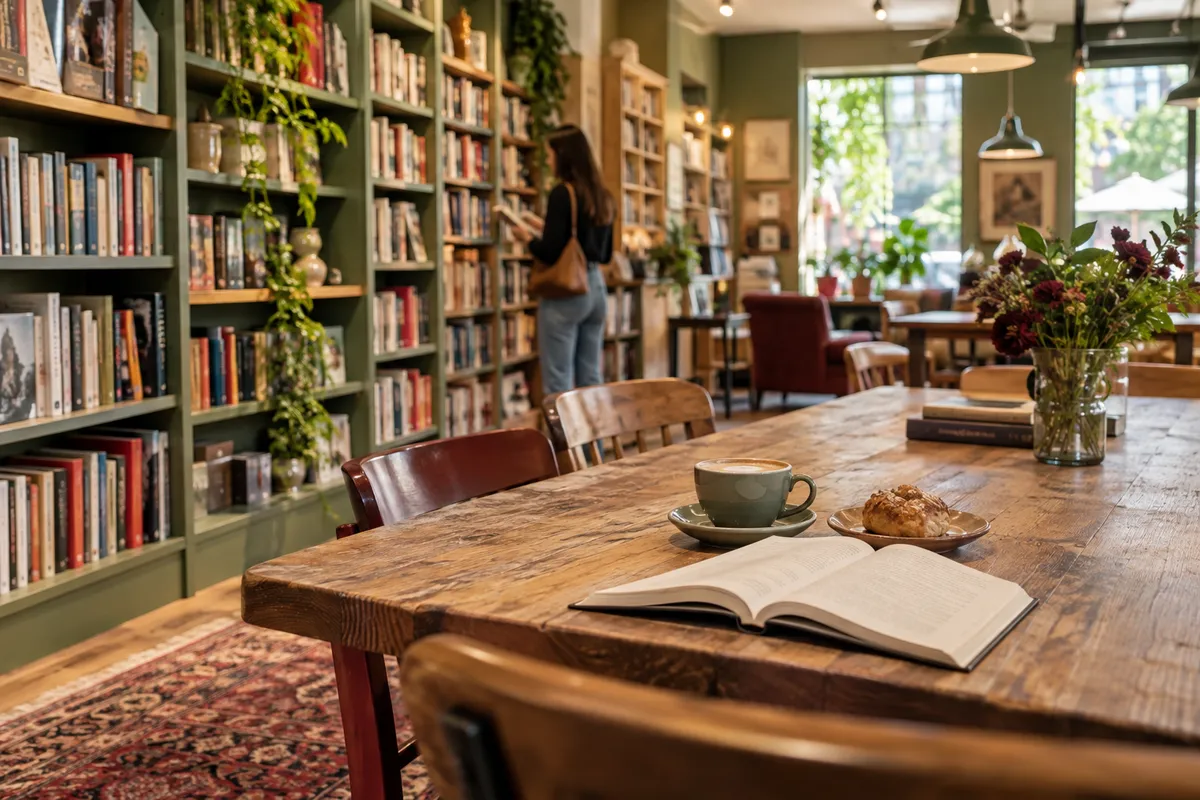
The broader context in the Forbes piece is the idea of experiential retail and the "third space," the place that's neither home nor work where people go for community, leisure and escape. That appetite has been especially strong post-pandemic, per the reporting. Independent bookstores, meanwhile, are reinventing themselves as lifestyle destinations to compete with digital retail and to give customers a reason to stay.
Think about the math from the shop's side. An online retailer can ship you a novel in a cardboard box. It cannot hand you a flat white and a pastry while you decide between two novels. A café gives a bookstore something a website can't replicate: a reason to sit down.
For readers, the trade is just as obvious. Browsing is lovely, but browsing with a table is better. Anyone who has ever read the first chapter of a book standing in an aisle, feeling vaguely like a loiterer, understands the appeal of a place that actively wants you to settle in.
The Cookbook Corner of the List
Two entries stand out for a particular reason. Book & Cook and Books for Cooks both lean into the food side of reading, at least judging by their names. If you're someone who treats cookbooks as literature (and plenty of us do, reading them in bed like thrillers), the pairing makes a kind of poetic sense: a place that sells recipes and a place where you can eat while you consider them.
I can't tell you what's on their menus, because the source material doesn't say, and I won't guess. What I can say is that the concept is a natural fit. Few retail experiences are as dangerous as reading about a dish and then smelling something similar from the next room.
A Geography Lesson in Hybrid Spaces
The spread of the list is the other quiet point. Forbes isn't describing a single city's hip neighborhood or one country's quirk. It's pulling from Europe, the Middle East-Europe crossroads of Istanbul, Southeast Asia and the northeastern United States. A trend that shows up in Manila and Vienna and Boston at once is less a fad than a shared answer to the same question: how does a small bookshop stay relevant?
That's a take, to be clear, and the roundup only shows seven examples. But seven spots across that many cities make the pattern hard to dismiss.
How to Use the List
If you're traveling, the list works as a built-in excuse. Heading to Lisbon? You now have a brunch plan. Copenhagen? A reading spot. Boston, where Beacon Hill Books & Cafe sits, is easy to add to a long weekend, and it requires no passport at all for a good chunk of readers.
If you're staying put, the more useful takeaway might be local. The concept Forbes describes doesn't require a famous address. It requires a shelf, a counter and someone willing to let you stay a while. Odds are a version of that exists within a short drive of you, and it's worth searching for one.
The Plot Twist
The funniest thing about the bookstore-café boom is how old-fashioned the product is. In an age of infinite scrolling and one-click delivery, the most competitive move a bookshop can make is to offer a chair, a hot drink and permission to ignore your phone for an hour.
That's not retail reinvention so much as retail remembering what it was for. And if the cure for digital fatigue turns out to be a croissant next to a stack of paperbacks, the list of seven suggests a lot of people are already ordering it.